Brand guide
How to Train Creators to Make TikTok Shop Videos That Sell
By the Creator2Commerce team · Published · Updated · 8 min read
Short answer
Train TikTok Shop creators with a one-page brief: the product's real features and benefits, one angle, a product-related hook, a hands-on demo, a clear call to action, and the claims they must avoid. Then review each video against the brief and send specific feedback before the next batch.
Key takeaways
- Brief every creator on one page: real features, one angle, a product-led hook, a hands-on demo, a clear CTA, and claims to avoid.
- Coach product-in-hand demos; lip-syncs and static images don't sell.
- Keep every claim aligned with the listing and disclose the partnership.
- Run a feedback loop on every batch so each round of videos beats the last.
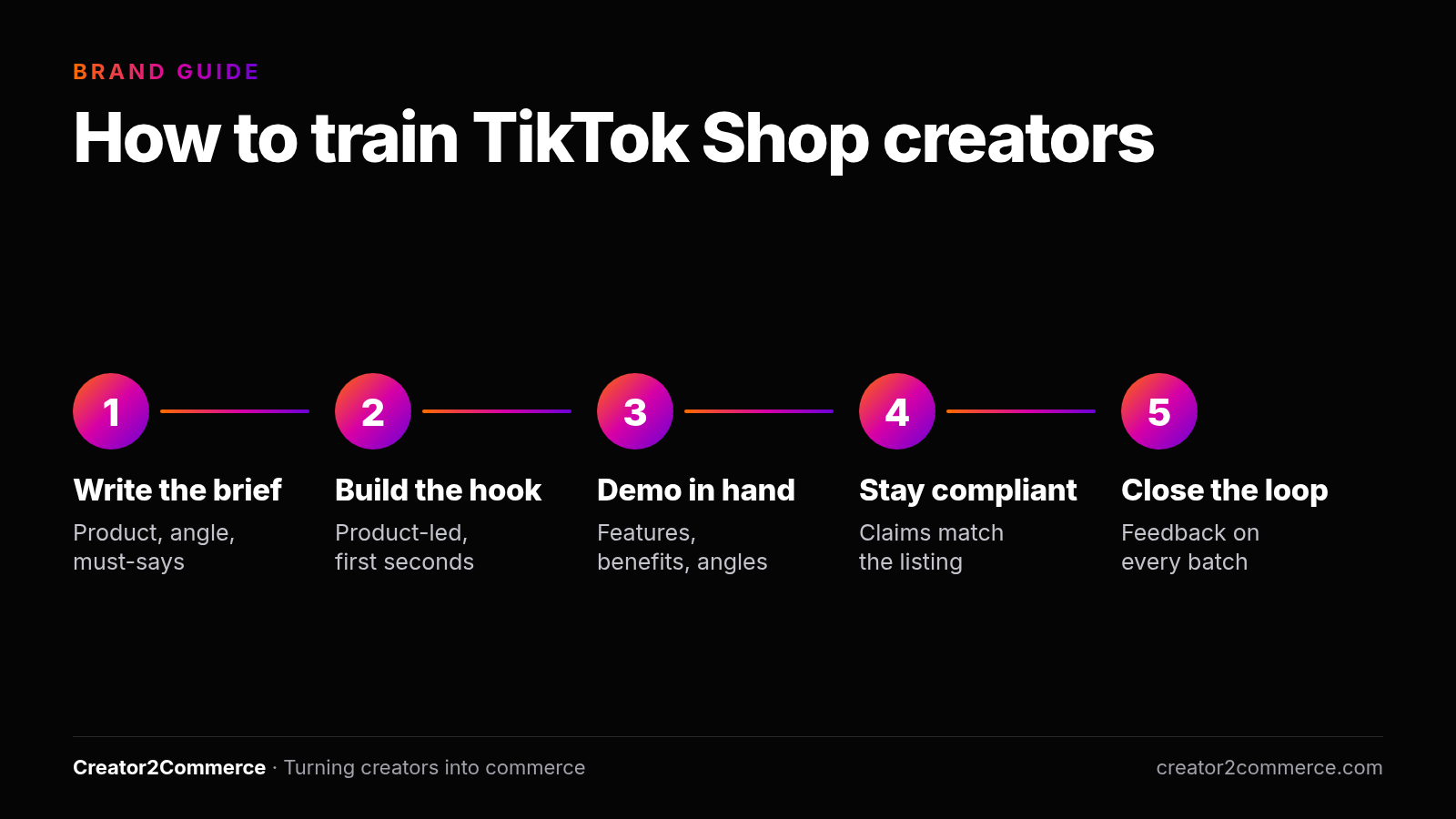
This guide is for brands that want creators to make better TikTok Shop videos without turning them into scripted ads. It covers what a brief contains, how to coach hooks and product-in-hand demos, a do and don't list, claims and disclosure, and a feedback loop. It is not legal advice, and it does not promise any result. TikTok and FTC facts come from the pages listed at the bottom.
What goes into a creator brief?
A good brief is short enough to read in a minute and specific enough that a creator can start filming. TikTok's seller guide says to tailor it by creator tier: for mega and macro creators, give the necessities (key selling points and messages) and let them handle the rest; for mid-tier and micro creators, give a content framework plus key messages and room to be creative; for nano creators, give something simple and clear they can film right away.
Put these in the brief:
- The product and who it is for. One sentence on the buyer and the problem it solves.
- Two or three features and their benefits. TikTok defines a feature as a fact about the product and a benefit as what the customer gets from it. Both must match your listing.
- One angle to try. For example a problem-and-solution demo, a "what I use it for" routine, or a comparison with how they did it before (with no false claims about other products).
- Shots to include. Product in hand, close-ups of the details, the product in use.
- Must-say and must-not-say. Your approved claims and the ones to avoid (see below).
- Disclosure line. How the creator should show they received a free product or a commission.
- Deadline and contact. Creators have 14 days to post after receiving a free sample, and TikTok sends reminders. Say who to message with questions.
Point creators to TikTok's own guidance on quality video too. It saves you from answering the same questions repeatedly.
How do you coach a strong hook?
The hook is the first line or shot, and it decides whether someone keeps watching. TikTok's quality-video guidance lists hook techniques seen in strong videos:
- eye-catching on-screen text, such as "Stop! We all need this kitchen tool";
- showing the result in the first seconds;
- a bold opening statement from the creator.
Ask the creator for two or three different hooks for the same product and compare them later. Hooks must be accurate. If the first line is "this fixed my problem in a day", it has to be true, and it falls under the claims rules below. A hook that names a real, specific problem is both safer and clearer.
What should a product-in-hand demo show?
TikTok's guidance says viewers do not have the product with them, so they rely on what they hear and see. It suggests the creator:
- describes features and benefits out loud, and shows each one as they say it;
- uses close-ups for details and a long shot for the full product;
- shows how it looks and works in the hand, as a real person using it;
- keeps the product visible, with no text or stickers laid over it;
- keeps what they say and what they show in sync (if the product comes in two colors, show both).
Creator2Commerce's home page describes vetting creators on whether their last 10 videos show the product in hand. Training reinforces the same standard after you hire: a clear, honest demo beats a polished but vague video.
What are the do's and don'ts for TikTok Shop creator videos?
Do:
- show the actual product you listed, and match its details and price to the product page;
- share a real opinion from real use of the product;
- show the product from several angles and in use;
- keep promotions accurate and easy to understand;
- send the draft or a plan to you first if you want to check claims before posting.
Don't:
- make false, inaccurate or exaggerated product claims, or claim awards or certifications the product does not have;
- use unsupported price comparisons or malicious comparisons with other products;
- use filters, edits or AI effects that make the result look better than it is;
- use still images, slideshows or copied content in place of a real product video;
- send viewers to buy outside TikTok Shop.
TikTok says violations can lead to content removal or account action. Give the creator this list, in your own words, so they can check their own videos.
How do you keep claims and disclosure compliant?
Two separate things matter: what the video says and whether the creator discloses the relationship.
Claims. TikTok's "How to Avoid Misleading Content" guide says claims, product attributes, pricing and demos must match the product detail page and packaging. Only use "results may vary" language for before-and-after or time-based results, as TikTok describes. If a claim needs proof, such as a test or a certification, keep the proof on file or leave the claim out.
Disclosure. The FTC's Endorsement Guides say a material connection to a brand must be disclosed clearly if the audience would not expect it. That includes payment and free or discounted products, even if the brand does not ask for a post in return. They also say a brand can be liable for a deceptive endorsement even when the endorser is not, and recommend that brands guide, monitor and act. In practice: put the disclosure line in the brief, check it in each video, and ask for a fix when it is missing.
We are not lawyers. Ask yours about regulated categories such as health, supplements and beauty claims.
How do you run a feedback loop?
Training does not end with the brief. A simple loop keeps quality rising without long meetings:
- Check each video against the brief. Product in hand? Claims correct? Disclosure present? Hook clear?
- Read the numbers. Affiliate Center shows each completed sample's views, likes, comments and orders. Look at the video, not only the total.
- Send short feedback. One thing that worked, one or two things to change next time.
- Share a reference. TikTok suggests sharing quality shoppable content from other creators as a reference during production.
- Update the brief. Keep what the strongest videos have in common and add it. Drop what did nothing.
- Follow up at key moments. Sample shipped, 7 days before the deadline, content live, as TikTok suggests.
Creators who respond well, post on time and stay on-claim are the ones to keep. See how to retain TikTok Shop creators for the next step, and how to hire TikTok Shop creators if you need to refill the roster. The first batch is covered in how to run a TikTok Shop creator seeding campaign.
Frequently asked questions
Should I script a creator's video word for word?
Usually not. TikTok suggests giving creators key messages and room to create. The FTC's guides also say an endorsement has to reflect the endorser's honest opinion or experience. Give talking points and claims to avoid, not lines they do not believe.
How long should a creator brief be?
Short enough to read in about a minute. There is no official length. Lead with the product, the angle and the do's and don'ts, and link to anything longer.
Can creators show before-and-after results?
TikTok's quality guidance includes before-and-after demos, and its misleading-content guide says "results may vary" language is for before-and-after or time-based results. The results must be real and the video must not use edits, filters or AI effects to enhance them.
Who is responsible if a creator makes a false claim?
Both can be. The FTC's rule says an advertiser can be liable for a deceptive endorsement even when the endorser is not, and that endorsers can be liable for their own false statements. Written guidance and spot checks help. This is general information, not legal advice.
Want to talk it through?
Creator2Commerce is a TikTok Shop agency for US DTC brands, founded by Anas Gull. If you want help hiring, retaining or training creators for your shop, book a call with the team.
Sources (read October 28, 2026)
- 8 Tips for Successful Seller & Creator Matchmaking (TikTok Shop Academy, dated 05/14/2026)
- Suggestions for Creating High-Quality Shoppable Videos on TikTok Shop (TikTok Shop Academy, dated 06/11/2025)
- How to Avoid Misleading Content (TikTok Shop Academy, dated 06/25/2026)
- How to set up and manage samples (TikTok Shop Academy, dated 07/16/2026)
- 16 CFR 255.1, General considerations (FTC Endorsement Guides, eCFR)
- 16 CFR 255.5, Disclosure of material connections (FTC Endorsement Guides, eCFR)
- Creator2Commerce home page (product-in-hand vetting description): creator2commerce.com